
Designing Control Into an Automated System
Foureyes is an automotive data platform with sales enablement and BI applications that help auto dealers maximize marketing ROI and sell more cars.
When Foureyes launched PE+, our AI-powered outreach product quickly found traction with hundreds of dealerships across the country.

Lake Oswego, Oregon
2015
Automotive Tech
$9.2 million (2025)
100 Employees
Challenges at launch
However, a critical friction point emerged: dealerships were overwhelmed by incorrectly automated messages and urgently needed a way to suppress unwanted outreach. At launch, suppressing messages took an average of 30 minutes per account, a costly and repetitive workflow that slowed support response and eroded customer trust.
This issue was flagged as a product risk with real business impact needing a rapid yet reliable solution.
Results
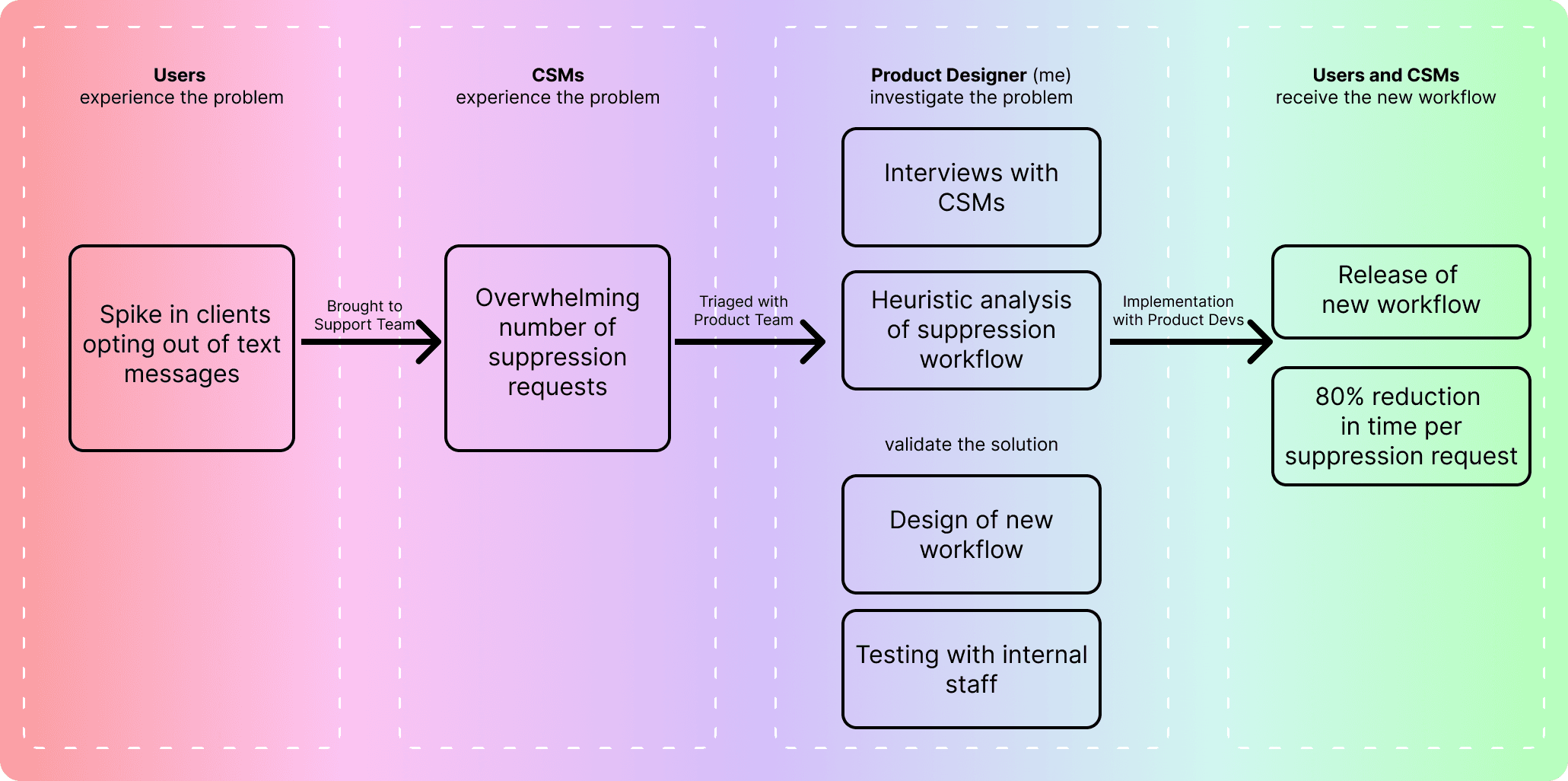
Within a single sprint, we shipped the redesigned suppression experience. The measurable results were clear:
Time to suppress outreach dropped from ~30 minutes to ~5 minutes, an 80% reduction in workload for support teams.
Customer Success reported immediate relief in their daily workflows and increased confidence in product responsiveness.
The rapid resolution strengthened cross-team trust and improved stakeholder confidence in our shared decision process.
30 min
Old suppression flow
5 min
New suppression flow
80%
Workload reduction
From Firefighting to Flow
This work led to a feature fix to address the needs of the moment and it reaffirmed a decision-framework I use regularly:
Diagnose with targeted qualitative input when time is limited.
Surface structural workflow issues instead of tactical UI patches.
Balance product risk and business continuity in high-stakes environments.
Align and influence cross-functional stakeholders through strategic articulation of trade-offs.
The outcome came as measurable efficiency gains and an improved approach to tackling similar operational challenges across product teams.
Role & Responsibility
As the Lead Product Designer embedded in the product team, I was responsible for diagnosing the root causes, defining a strategic solution approach, aligning cross-functional partners, and delivering a high-impact fix within one business week.
All without the benefit of extended research cycles typical in our product process.
Strategic Approach
Rather than jumping straight to UI adjustments, I led a rapid discovery phase to understand where the work was breaking down across the workflow:
Conducted targeted interviews with Customer Success Managers who were closest to the problem and the affected users.
Ran a heuristic analysis of the existing suppression flow to uncover structural design issues.
Mapped critical pain points against business and technical constraints to ensure solution decisions balanced user value with implementation risk.
This diagnostic work reframed the problem from “make suppression faster” to “eliminate unnecessary complexity in the suppression workflow.”
Key Decisions & Design Strategy
From insights emerging in our analysis, I defined a solution framework that focused on workflow simplification and systemic improvement:
Reorganized the settings page to group related controls logically and reduce cognitive overhead.
Transitioned suppression controls from campaign-level to a global suppression model, eliminating redundant actions.
Replaced a scattershot dropdown UI with a searchable multi-select modal, significantly increasing task efficiency and reducing error.
Throughout this process, I coordinated closely with engineering and CSM leadership to ensure alignment on feasibility, trade-offs, and risk mitigation.
UI Issues becoming Systemic Risks
Rather than enumerating individual UI issues, I grouped findings into three systemic risks that were actively harming the business and support team.
1. Loss of Human Control in an Automated System
(Risk: irreversible customer actions)
Operators couldn’t confidently pause, reverse, or verify actions
Automation failures required engineering intervention
Result: high-stress workarounds + delayed response times
2. Cognitive Overload Under Time Pressure
(Risk: errors during live suppression events)
Critical actions buried in dense UI
No clear “safe path” during emergencies
Result: slow decisions and accidental misfires
3. Ambiguous System Feedback
(Risk: loss of trust in the platform)
Operators unsure whether actions succeeded
Required manual cross-checking
Result: duplicated work and hesitation
Design Changes
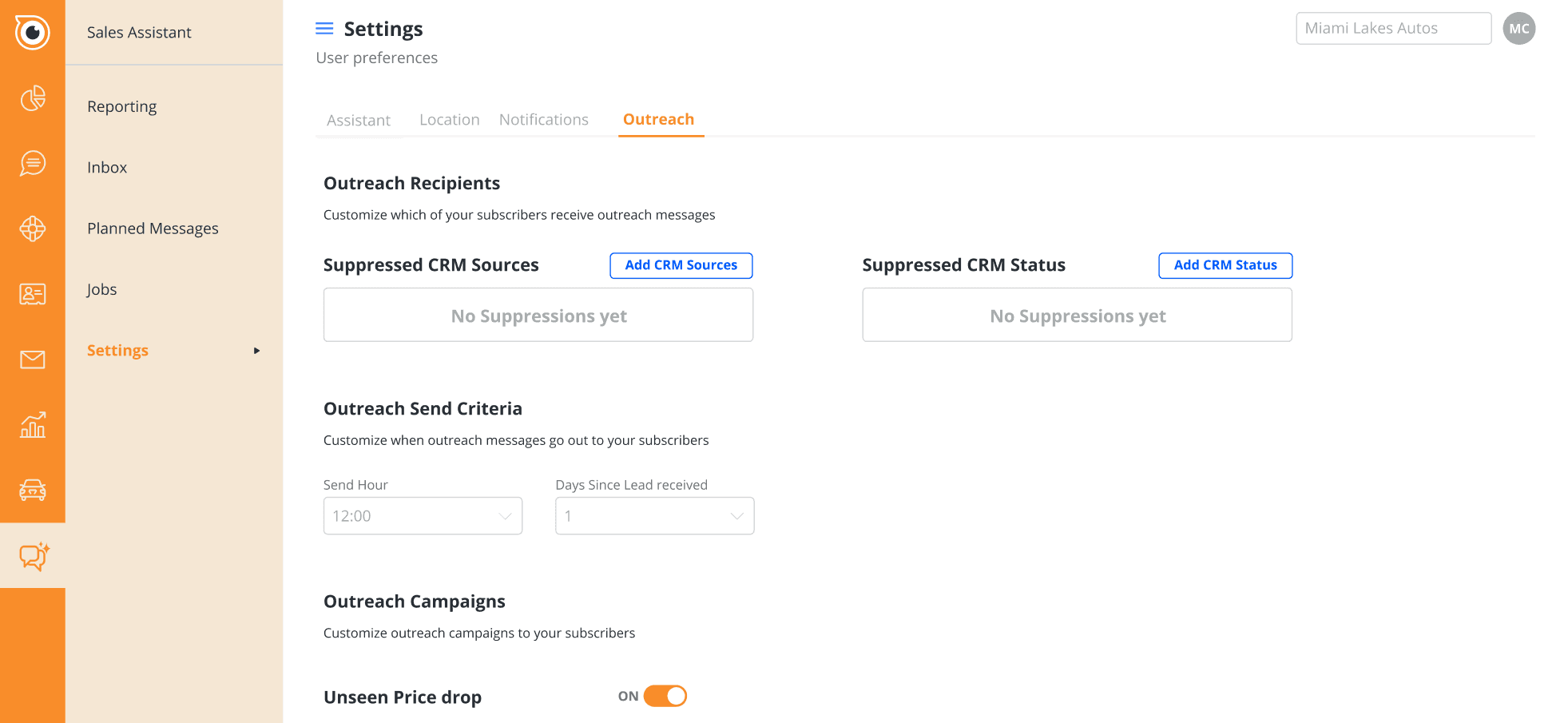
From my investigation, it was clear that it took so long to suppress messages because the settings menu was chaotic. The options in the settings menu were disorganized, and it was too difficult to search for people to add to the exclusions list.
My solution overhauled the settings page in 3 major ways:
A modal with search and multi-item select for adding suppressions to the exclusions list replaced the clunky pills and drop down system
The exclusion lists became a global setting, instead of being individual to campaigns
The settings page was reorganized into tabs so that every view served a more specific purpose
When I presented this solution to the CSM team and had them try it out, the feedback was simple:
“Hell yeah, Ship it now!”
Seth M
Manager, Customer Success team at Foureyes

Conclusion
With the CSM team's emphatic support of the new design, I worked with the Product Developers to get the new settings page live within the week.